
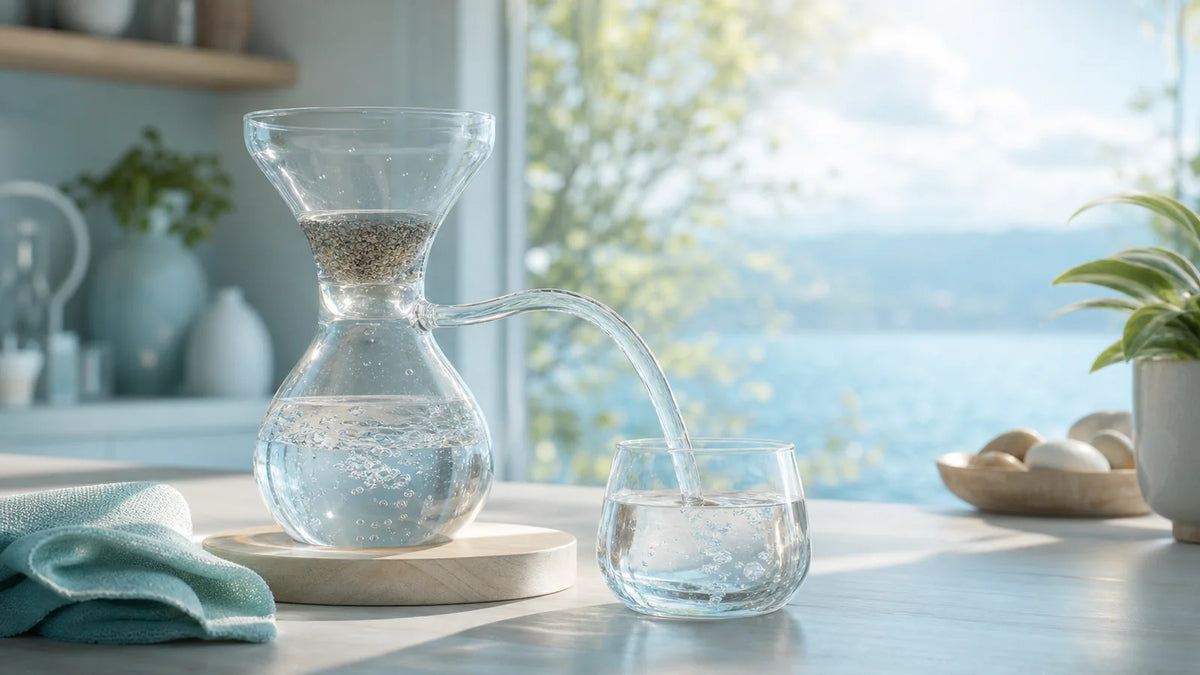
The first sediment stage protects more specialised media from physical loading.
Evidence snapshot
- NHMRC (2025): The Australian Drinking Water Guidelines are a risk-management framework, not a single national pass/fail law. They separate health-based, aesthetic and operational considerations.
- NSF (2026): NSF standard numbers are not quality rankings. NSF/ANSI 42 covers stated aesthetic claims, 53 health-effect claims, 44 softeners, 55 UV and 58 point-of-use RO; the exact certified claim still has to be checked.
- Water Analytics Australia (2026): WAA's current whole-home page describes staged sediment, carbon and complementary treatment, optional under-sink RO, consultation and ongoing filter support. Exact claims still need to match the supplied configuration.
- Water Analytics Australia (2026): WAA describes its benchtop as a no-plumbing unit combining RO, UV, mineral boost, temperature choices and an optional hydrogen-rich mode. These functions should be assessed separately.
These figures and standards are reference points, not a diagnosis of one home. Local water data, premises plumbing, flow and maintenance determine how they apply.
What the first observation can tell you
Start with the property itself. A multi-stage system works only when each stage has a defined job and enough capacity at the intended flow. Sediment protection, adsorption, redox processes, scale management, UV and RO are not interchangeable labels. The proposal should explain stage order, service triggers and how performance will be checked after installation.
Where the claim stops
Providing a Lifetime Free Sediment Filter can reduce one recurring consumable cost and encourage timely replacement.
Official guidance describes population-level or supply-level risk; a component test describes stated test conditions; a household observation describes one property. None should silently stand in for another. Connect them only where the source, configuration and operating conditions genuinely match.
Use condition and service data, not colour alone
Customers should still confirm inclusions, freight or service charges, eligibility and the correct element.
Keep the cartridge code, installation date, clean pressure and estimated volume in one service record. At change time, isolate the water, release pressure, inspect the housing and seal, fit the correct part and recommission according to the product instructions. A clean-looking cartridge may be chemically exhausted; a brown cartridge may still need pressure and volume data to judge its condition.
What to record before buying
Free supply is valuable because the stage has a real protective job, not because sediment is the only treatment needed.
Decide how the claim will be checked after installation. That may be a pressure reading, service-volume record, alarm status, hardness test or matched laboratory samples. Also write down who acts when the trigger is reached. A result without a maintenance response is not a complete treatment plan.
A practical household check
| Record | What to capture | Why it changes the decision |
|---|---|---|
| Stage job | Map each medium to one target | Makes the design auditable |
| Hydraulics | Check media volume and design flow | Protects contact time |
| Service | Set replacement and verification triggers | Maintains the result |
Use the same notes when requesting more than one quote. Suppliers then have to answer the same water, flow and ownership brief rather than redefining the problem around their preferred product.
Where Water Analytics Australia fits
WAA's role is to turn the household brief into a proportionate design. That starts with source water, treatment goal, realistic peak flow, available pressure, installation access and the preferred service approach. Depending on the job, the answer may be whole-home staged treatment, point-of-use RO, the benchtop system or a combination. The written proposal should explain why each stage is present, the conditions behind each claim and what the customer will need to maintain.
Related WAA guides
- What Happens at Your Next Filter Change? Inside FuturePure Protection
- Coconut Shell Carbon: Why Carbon Source and Manufacturing Quality Matter
- WAA Full Home Water Refining Systems
Common questions
Why not rely on carbon alone?
Carbon is useful for defined adsorption jobs. Sediment, hardness, microbes and many dissolved substances may require different mechanisms. Every extra stage still needs enough capacity and a service plan.
What is the most useful measurement?
Use the measurement that matches the decision. A multi-stage system works only when each stage has a defined job and enough capacity at the intended flow. Sediment protection, adsorption, redox processes, scale management, UV and RO are not interchangeable labels. The proposal should explain stage order, service triggers and how performance will be checked after installation.
What should WAA receive before recommending a system?
Provide the postcode, water source, household size, bathroom count, busiest-use pattern, observed issue, desired result and any laboratory report with its units and sample point.
Sources and further reading
- NHMRC: Australian Drinking Water Guidelines, version 4.0
- NSF: Standards for water treatment systems
- Water Analytics Australia: Full Home Water Refining Systems
- Water Analytics Australia: 5-in-1 Hydrogen-Rich Benchtop Water System
The next useful step
Write down the source, the result you want, peak-use flow and the evidence already available. Then ask for a recommendation that gives every stage a defined job, states the operating assumptions and includes the service plan. That is enough detail to compare a WAA proposal with any alternative without relying on fear or brochure language.