
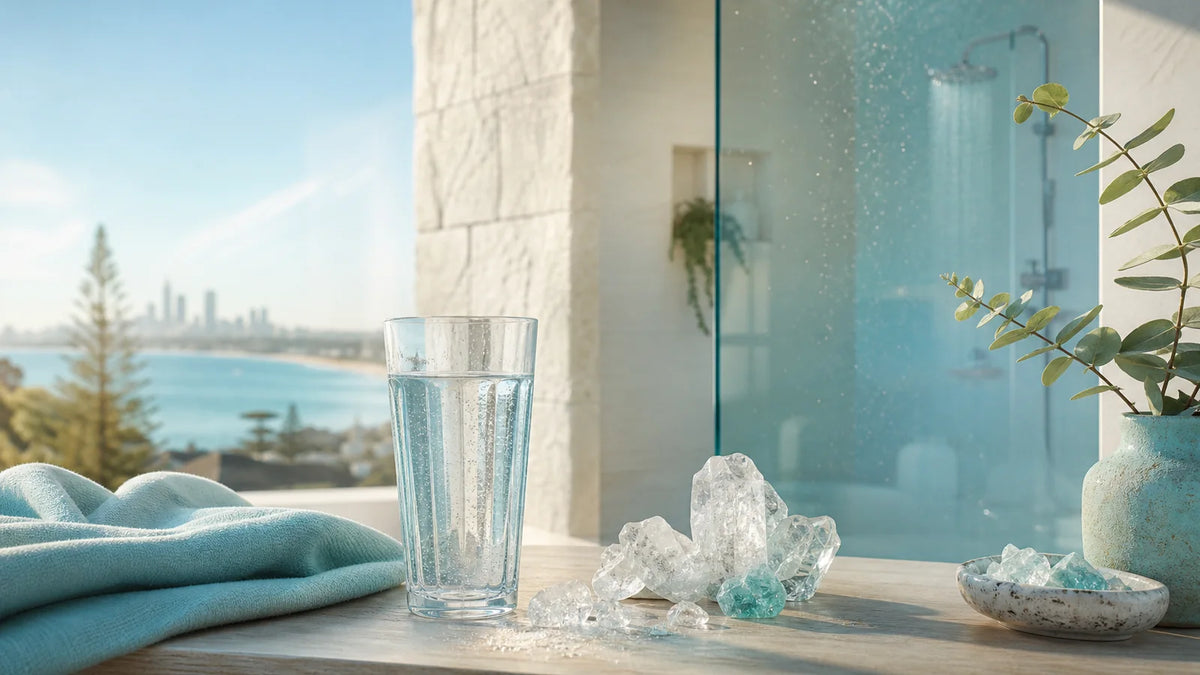
Perth water can come from a blend of groundwater, desalination and surface sources, so hardness and taste can vary by locality.
Evidence snapshot
- NHMRC (2025): The Australian Drinking Water Guidelines are a risk-management framework, not a single national pass/fail law. They separate health-based, aesthetic and operational considerations.
- NSF (2026): NSF standard numbers are not quality rankings. NSF/ANSI 42 covers stated aesthetic claims, 53 health-effect claims, 44 softeners, 55 UV and 58 point-of-use RO; the exact certified claim still has to be checked.
- Water Corporation (2026): Water Corporation reports a diverse WA supply system and about 70,000 samples with more than 365,000 individual analyses. Perth cannot be reduced to one fixed source-water profile.
- Water Corporation (2026): Water Corporation explains that hard water can leave spots after evaporation while still meeting health requirements. Hardness is primarily a household and appliance-management question, not proof of unsafe water.
These figures and standards are reference points, not a diagnosis of one home. Local water data, premises plumbing, flow and maintenance determine how they apply.
Decide whether you want scale control or hardness removal
Start with the property itself. First compare cold water at two or three taps, then compare hot and cold. Check the utility's current notice and local report. If the issue appears only after water has sat in one fixture, investigate that fixture before changing the whole-house system. Carbon selection, media quantity and contact time should then be matched to free chlorine or chloramine rather than inferred from smell.
Keep the sample, unit and reporting limit together
Water Corporation reports that chlorine is used across its schemes and publishes regional quality information.
Write the sample point, date, method, unit and laboratory reporting limit beside the result. A kitchen first-draw sample answers a different question from water collected after a two-minute flush. For a treatment check, use matched inlet and outlet samples and the same method. Do not use taste, colour or a TDS pen as a substitute for analysis of a named contaminant.
How to verify the outcome
A useful treatment plan separates aesthetic goals, scale management and any verified contaminant concern instead of treating the whole city as one water profile.
Measure hardness in mg/L as calcium carbonate and decide what result matters. Fewer deposits, lower measured hardness and low-mineral drinking water are three different goals. Scale-control media aim to change deposit behaviour; ion-exchange softeners remove calcium and magnesium; RO separates many dissolved ions at a drinking-water point. Put the intended result in writing before comparing systems.
A practical household check
| Record | What to capture | Why it changes the decision |
|---|---|---|
| Local data | Download the postcode or supply-zone report | Avoids city-wide assumptions |
| Property check | Compare several cold taps | Finds premises-plumbing clues |
| Goal | Separate taste, scale and contaminant concerns | Matches the treatment job |
Use the same notes when requesting more than one quote. Suppliers then have to answer the same water, flow and ownership brief rather than redefining the problem around their preferred product.
Where Water Analytics Australia fits
WAA's role is to turn the household brief into a proportionate design. That starts with source water, treatment goal, realistic peak flow, available pressure, installation access and the preferred service approach. Depending on the job, the answer may be whole-home staged treatment, point-of-use RO, the benchtop system or a combination. The written proposal should explain why each stage is present, the conditions behind each claim and what the customer will need to maintain.
Related WAA guides
- Sydney Tap Water Guide: Chlorine, PFAS, Hardness and the Right Filter
- Melbourne Tap Water Guide: What’s in It and When Filtration Makes Sense
- WAA Full Home Water Refining Systems
Common questions
Can a postcode tell me which filter to buy?
No. It can locate the utility report and likely supply area, but premises plumbing, household goals, peak flow and any contaminant-specific test still affect the design.
What is the most useful measurement?
Use the measurement that matches the decision. Write the sample point, date, method, unit and laboratory reporting limit beside the result. A kitchen first-draw sample answers a different question from water collected after a two-minute flush. For a treatment check, use matched inlet and outlet samples and the same method. Do not use taste, colour or a TDS pen as a substitute for analysis of a named contaminant.
What should WAA receive before recommending a system?
Provide the postcode, water source, household size, bathroom count, busiest-use pattern, observed issue, desired result and any laboratory report with its units and sample point.
Sources and further reading
- NHMRC: Australian Drinking Water Guidelines, version 4.0
- NSF: Standards for water treatment systems
- Water Corporation: Drinking water quality in Perth and Western Australia
- Water Corporation: What is hard water?
The next useful step
Write down the source, the result you want, peak-use flow and the evidence already available. Then ask for a recommendation that gives every stage a defined job, states the operating assumptions and includes the service plan. That is enough detail to compare a WAA proposal with any alternative without relying on fear or brochure language.