
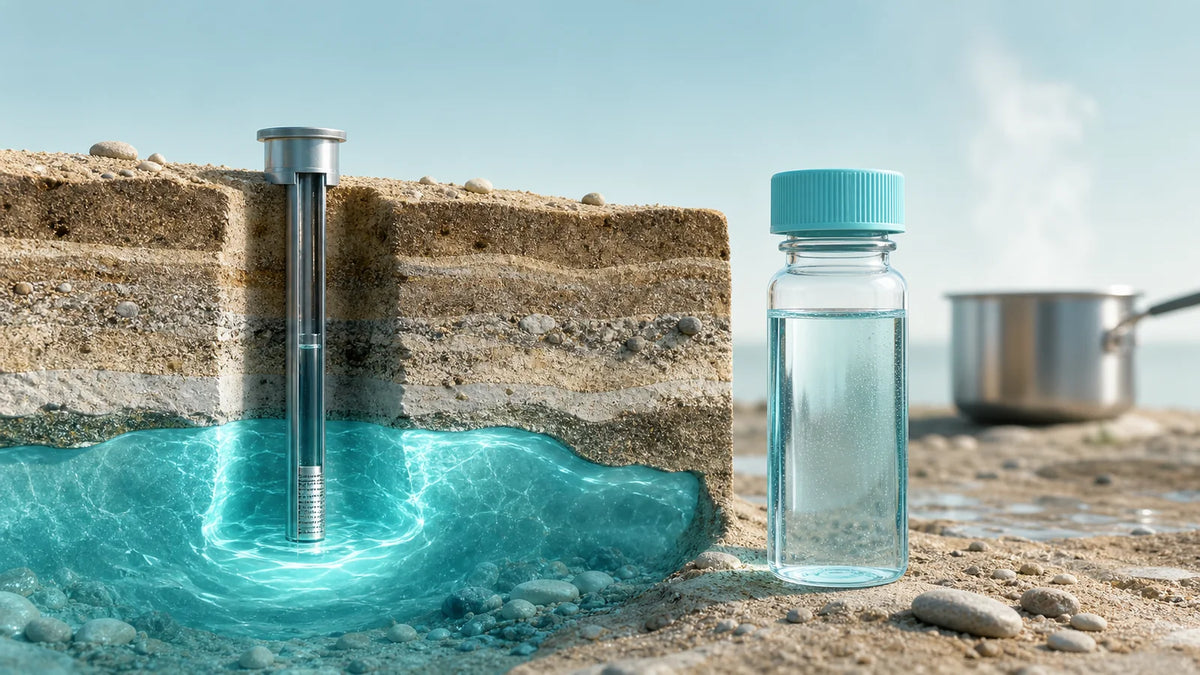
If a bore supplies drinking water, test for nitrate rather than trying to judge it by taste or clarity. Nitrate is dissolved, colourless and not reliably removed by boiling or a conventional activated-carbon cartridge. Treatment selection starts with a laboratory result in the correct units.
The Australian numbers and who they protect
The Australian Drinking Water Guidelines list a nitrate value of 50 mg/L as nitrate (NO₃) to protect bottle-fed infants under three months. They note that adults and children over three months can safely drink water containing up to 100 mg/L nitrate, while the guideline for nitrite is 3 mg/L as nitrite (NO₂).
These age-specific statements are important. They should not be compressed into “50 mg/L is safe for everyone” or “anything above 50 mg/L is immediately toxic”. If an infant may consume formula prepared with bore water, obtain current health advice and a suitable test before use.
Check the unit before comparing a result
Laboratories may report nitrate as nitrate ion (NO₃) or as nitrate-nitrogen (NO₃–N). Those values are not numerically equal.
nitrate as NO₃ ≈ nitrate as N × 4.43
For example, 11.3 mg/L nitrate as N is approximately 50 mg/L nitrate as NO₃. A report showing “12 mg/L” cannot be interpreted responsibly until the reporting basis is known.
| Laboratory notation | Example result | Approximate equivalent |
|---|---|---|
| Nitrate as N | 11.3 mg/L | 50 mg/L as NO₃ |
| Nitrate as NO₃ | 50 mg/L | 11.3 mg/L as N |
Use the laboratory’s notation and conversion advice rather than guessing from a search result produced in another country.
Why bore water is source-specific
Nitrate can enter groundwater from fertilisers, animal waste, septic systems and natural processes. NHMRC notes that most Australian water supplies contain less than 15 mg/L nitrate, but higher concentrations can occur in rural groundwater. A neighbour’s result does not describe your aquifer, bore depth, casing condition or nearby land use.
WA Health advises annual chemical and microbiological testing by a NATA-accredited laboratory when bore water is used for drinking. Test frequency may need to increase after flooding, land-use change, bore work or a prior elevated result.
Boiling can make the concentration higher
Boiling kills susceptible microorganisms when used correctly, but nitrate does not evaporate with the steam. As water volume falls, the dissolved nitrate remains and can become more concentrated. This is why boiling must not be recommended as a nitrate treatment.
A simplified example:
- 2 litres at 60 mg/L contains 120 mg of nitrate.
- If boiling leaves 1.5 litres and no nitrate is removed, the concentration becomes 80 mg/L.
Real kitchens do not make precise laboratory evaporators, but the mass balance explains the direction of change.
Why ordinary carbon is not the nitrate stage
Activated carbon is useful for defined adsorption tasks such as chlorine-related taste and odour. Nitrate is a dissolved ion and is not removed by conventional carbon filtration. A system that combines carbon with another technology may address nitrate through that other stage, but the claim must identify it.
WA Health lists reverse osmosis, distillation and deionisation among processes capable of removing nitrate, subject to correct design and maintenance. Anion exchange can also be engineered for nitrate, but resin selectivity, competing sulphate, regeneration and waste management require professional specification.
Treatment is a measured performance problem
For reverse osmosis or ion exchange, ask:
- What is the raw-water nitrate result and unit?
- What other ions, hardness, iron, manganese or salinity affect the process?
- What exact nitrate-reduction evidence supports the model?
- At what flow and capacity was it tested?
- How will post-treatment nitrate be verified?
- What happens during bypass, exhaustion, membrane failure or power loss?
If drinking-water treatment is point-of-use, ensure untreated outlets cannot be confused with the drinking tap. If treatment is whole-of-house, the required flow and waste or regeneration arrangements change substantially.
Do not lose the microbiological barrier
Bore-water treatment must address the complete source profile. Nitrate removal does not disinfect water, and disinfection does not remove nitrate. The NHMRC framework says disinfection should never be compromised while managing other water-quality issues. Sediment control, treatment, disinfection and safe storage need to function as a coherent train.
Water Analytics Australia can review laboratory data and discuss filtration options for rural properties. The starting document should include microbiology, nitrate with units, major ions and any local contaminants of concern—not nitrate in isolation.
The practical rule
For bore water: test first, confirm the reporting unit, protect infants using current health guidance, and select treatment with an exact nitrate claim and a verification plan. Do not boil it away, and do not ask a standard carbon cartridge to perform an ion-removal job. Our bore-water treatment guide covers the wider test panel and treatment train.