
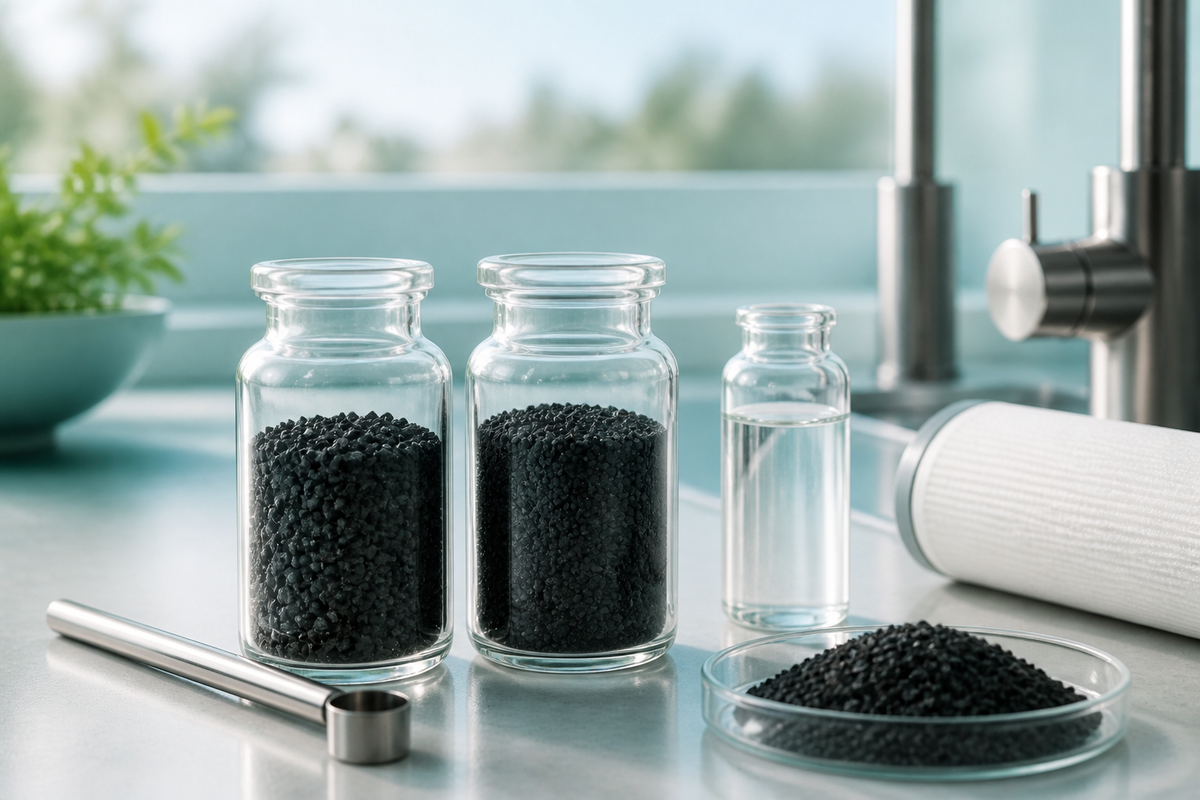
Activated carbon and catalytic activated carbon are related technologies, but they should not be treated as interchangeable labels. The useful comparison starts with the disinfectant or substance being considered, then looks at contact time, flow and capacity.
What activated carbon does
Activated carbon has a highly developed pore structure. Water-treatment applications use its surface area for adsorption and, in some cases, chemical reaction. It is widely used for chlorine, taste and odour objectives.
That does not mean every carbon cartridge supports every reduction claim. Carbon source, activation method, particle size, cartridge structure and water pathway all affect performance.
Why chloramine changes the question
Chlorine and chloramine both serve public-water disinfection roles, but chloramine is more persistent. CDC explains why utilities use these disinfectants and why a residual can remain as water travels through the network.
Conventional activated carbon may reduce chloramine, but catalytic activated carbon is engineered to improve the relevant reaction under suitable conditions. That is why “contains carbon” is not enough information when chloramine is the target.
Contact time and flow still matter
Water needs a useful pathway through the media. Higher flow or a smaller media volume can reduce effective contact time. As the carbon processes more water, its remaining capacity also changes.
A strong comparison therefore asks about the exact cartridge, rated flow, test volume and replacement guidance rather than relying on the carbon category alone.
How to read certification language
NSF/ANSI 42 treats chlorine and chloramine as specific testable claims. A certification or laboratory result must still be tied to the named product and claim scope.
Media data can help explain a material. It is not automatically proof for every finished system that contains that media.
Which carbon should you choose?
Start with the local disinfectant context and the household objective. Then compare the product-specific evidence, flow, contact time, capacity and maintenance route.
Next: read the Filtration Guide, review chlorine and chloramine context, or explore CarbonWeave™ technology.